Share
Do you really need an actuarial certificate to claim an ECPI?


Do you really need an actuarial certificate to claim an ECPI?

News | Mehak Gaba | Released: 01/04/2026 | Read: 5 Mins

This is one of the most frequently asked questions among professionals in the SMSF space, and the answer is not always straightforward. Many accountants, advisors, and trustees assume that claiming Exempt Current Pension Income (ECPI) automatically requires an actuarial certificate. However, this is not always the case.


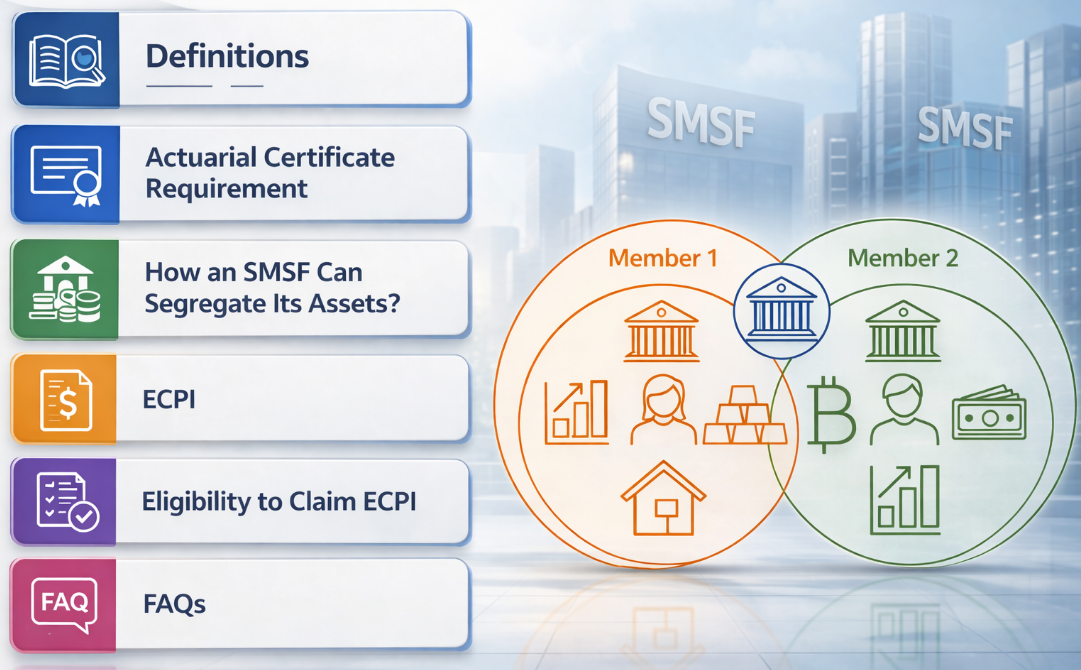
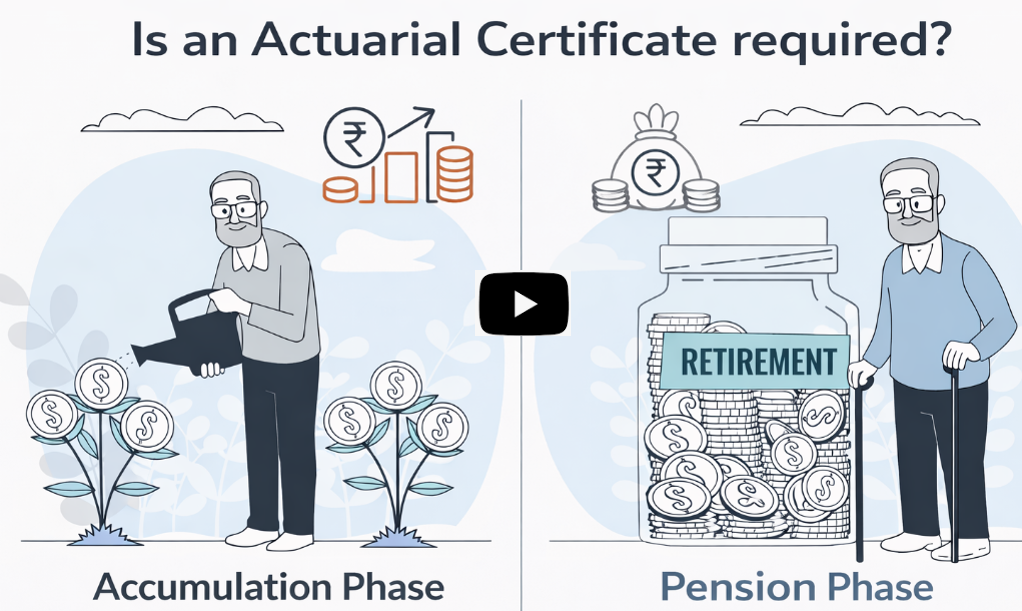
The requirement of Acturial Certificate depends on whether the fund’s pension assets are segregated or unsegregated. This newsletter breaks down each of these concepts in detail.

https://stratus.campaign-image.com.au/images/27408000028377004_zc_v1_1774402556662_screenshot_2026_03_25_070516.png
   

Defination of  Segregated & Unsegregated Pension Assets


Segregated Pension Assets: Under ITAA 1997, Section 295-385, assets are considered segregated current pension assets where they are invested, held in reserve, or otherwise dealt with solely to enable the fund to meet its liabilities in respect of superannuation income stream benefits, as and when they fall due.

Where an SMSF holds such segregated pension assets, the income derived from those assets is treated as Exempt Current Pension Income (ECPI). In these circumstances, an actuarial certificate is not required to claim ECPI.


Unsegregated Pension Assets: Under ITAA 1997, Section 295-390, where assets are not segregated,

a fund doesn't set aside specific assets to support retirement-phase income streams, the fund applies the proportionate (unsegregated) method to determine ECPI. This approach calculates a fair tax exemption based on the proportion of pension liabilities relative to total fund liabilities (excluding any segregated assets). In such cases, an actuarial certificate is required to determine the applicable exempt income percentage.


What is ECPI and how is it connected to an Acturial Certificate?


Exempt Current Pension Income (ECPI) determines the portion of an SMSF’s income that is tax-exempt when the fund is paying retirement phase pensions. An actuarial certificate plays a key role in calculating this exemption when the fund is not fully segregated.

How they are connected:

  • When an SMSF has a mix of accumulation and pension phase interests (i.e. unsegregated assets), it cannot directly identify which income is exempt.
  • In such cases, an actuary calculates the ECPI percentage based on the proportion of pension liabilities to total fund liabilities over the financial year.
  • This percentage is then applied to the fund’s total income to determine the tax-exempt portion (ECPI).


To be eligible to claim ECPI, the SMSF must satisfy the following minimum pension standards:


  • Income stream must be paid from a superannuation account held in the member’s name.
  • SMSF must have paid at least the minimum annual pension amount in F/Y in which ECPI is claimed.
  • Once the pension has commenced, the capital supporting the pension cannot be increased through additional contributions or rollovers.
  • Pension capital and associated income cannot be used as security for any borrowing arrangement.
  • Minimum pension payment requirements must be satisfied before any full or partial commutation of the pension.
  • In event of member’s death, pension can be transferred to a dependant beneficiary of that member.
   

How does SMSF Segregation of Assets work in practice? 

   
Regulation 5.03 of the SISR requires trustees to allocate investment returns to members in a manner that is fair and reasonable across all members and benefit types. Consider the following practices:
Step 1. For any SMSF decision, the first step is generally to check the trust deed. We need to ensure there is nothing specifically preventing segregation in the SMSF.
Step 2:  Review and update the fund’s investment strategy to ensure it is appropriate to the segregation method and each member’s preferences

Step 3: Decision is made in advance as to which specific assets are segregated and to which member account.

Step 4. Document the specific segregated assets set aside to support the pension. 
Step 5: Open a separate bank account  to receive income but it is possible to use sub accounts under the one universal bank account to separate the cash in relation to segregated assets.
Step 6: Expenses in relation to the segregated assets should be paid from the segregated bank account which also include pension payments when the pension assets are segregated.
๐Ÿงพ Example

Charlie’s SMSF holds 2,000 NAB shares, with 500 shares segregated to support his pension. Although dividends are received together under the same HIN, they relate to both segregated and unsegregated assets.


The trustee ensures that income from the 500 segregated shares (including imputation credits) is separately identified and allocated to a sub-account, with the cash either transferred to a segregated bank account or tracked within the same account.


๐Ÿ‘‰ This ensures proper tracking of income for segregated assets and no actuarial certificate is required.


Join my webinar on 23th April 2026


This session explores the key considerations around the segregation of assets between pension and accumulation phases, helping you better understand the rules, associated risks, and practical implications.


Cost: $50 


CPD: 1 Hour


Date: 23/04/2026


CPD: 1 Hour


๐Ÿ’กWhen might segregating assets becomes powerful?


๐Ÿงพ The Scenario (Without Segregation) An SMSF has two members, each with $1 million in accumulation at the start of the financial year. On 1 January, one member commences a retirement phase pension while the other member remains in accumulation phase. 


In the absence of segregation, the fund would obtain actuarial certificate for the entire year. It is likely that this certificate would show a percentage of approximately 25% - despite the fund being effectively 50% in pension phase for part of the year.


โš ๏ธ Why This Can Feel Unfair: At that time, the fund is effectively 50% in pension phase, so logically, you might expect 50% of the capital gain to be tax-free.  
 

However, in practice, only around 25% is treated as tax-free, as the exemption is determined based on a blended annual actuarial percentage, rather than the actual timing of pension commencement.


๐Ÿ‘‰ Practical Outcome of Segregation

  • Income before 1 January → fully taxable
  • Income after 1 January → higher tax-free proportion
  • Capital gains realised later in the year → significantly higher tax exemption (e.g. 50% instead of 25%)


Crux: When is an Acturial Certificate required or when is it not?


โœ… When your fund has mix of pension and accumulation accounts.


โœ… If assets are not clearly separated or partly segregated, the fund automatically falls under the "Unsegregated Pension Assets" and actuarial certificate is required for that period.


โœ… When fund contain a defined benefit pension at any point during the financial year. 


โŒ Fund is 100% in pension phase or 100% accumlation phase for the entire year.

โŒ Fund uses only segregated pension assets (and is eligible).


โŒ No Fund has member total superannuation balance exceeding $1.6 million and also holds a pension, the fund is not permitted to use the segregation method and forced to use the "unsegegrated method".


Visit www.trustdeed.com.au for more details or call us on(02) 9684 4199


Follow Us On

 You are receiving this email as you signed up for our newsletters.

 Want to change how you receive these emails?

You can Unsubscribe or Update your preferences

 
click here to unsubscribe from the mailing list
Share