Share
Who should bear SMSF establishment costs ?


Who should bear SMSF establishment costs ?

News | Mehak Gaba | Released: 18/03/2026 | Read: 5 Mins


Recent ATO guidance (Feb 2026) clarifies the treatment of SMSF establishment expenses.There has long been uncertainty around who should bear SMSF establishment costs and how these expenses should be treated for tax and compliance purposes.


Hence, recent guidance from the Australian Taxation Office (ATO) addresses this long-standing ambiguity and provides much-needed clarity on the issue. Below is an analysis of the key rules, practical steps, and compliance pitfalls.

https://stratus.campaign-image.com.au/images/27408000027729006_zc_v1_1773796813708_screenshot_2026_03_18_064923.png
   

Detailed ATO Guidance (Feb 2026) on SMSF set up Cost


The ATO “SMSF Newsroom” update (17 Feb 2026) reminds us that if a member pays SMSF setup costs personally, the fund can reimburse them – but only if done “the right way”. The ATO’s instructions are:


  1. The SMSF must charge the costs against the member’s benefits (via reg 5.02).
  2. Seek reimbursement as soon as the fund has enough cash (e.g. when the first rollover or contribution lands).
  3. Only costs actually incurred in establishing the fund qualify for this treatment.
  4. When handled correctly, reimbursement is not a contribution or a loan (“financial assistance”), so it won’t breach SIS s.67 or contribution rules.
  5. If reimbursement is not claimed, the trustee’s payment is “treated as a contribution” to the SMSF.

In other words, the ATO confirms that a prompt reimbursement avoids contribution or borrowing issues; failure to reimburse creates a reportable contribution (non-deductible capital contribution)


Legislative Framework as per the SIS Act, 1993

   
https://stratus.campaign-image.com.au/images/27408000027729006_zc_v1_1773817016238_screenshot_2026_03_18_122528.png
 
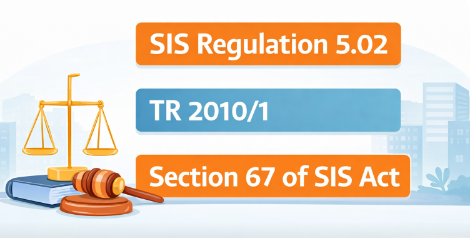
  • Under SIS Regulation 5.02, an SMSF is permitted to allocate certain expenses directly to members’ accounts.

    • Subregulation 5.02(2) allows direct costs of establishing, operating, or terminating the fund to be charged against member benefits.

    • This means setup costs are legally recognised as fund expenses.

    • Where a trustee initially pays these costs, the fund can reimburse the trustee and allocate the expense to the member’s balance.

    ✔ Practical takeaway: Reimbursement is valid only if the cost relates to the fund.

  • Section 67 of SIS Act 1993 (Borrowing prohibition). Section 67 states that, subject to limited exceptions, a regulated fund must not borrow money. While we cannot quote it directly here, in practice this means SMSFs may not incur loans or financial assistance. Crucially, the ATO’s ruling SMSFR 2009/2 clarifies that reimbursing trustee-paid costs (when done immediately) does not create a “borrowing” under s.67. In effect, if the trustee pays fees and the fund promptly repays them, it’s treated as an expense reimbursement – not a loan.
  • TR 2010/1 (Super contributions). This ruling defines when an amount is a superannuation contribution. Broadly, anything of value given to the fund by someone other than the fund itself is a "contribution". If the trustee pays setup costs and fails to seek reimbursement, the payment must be treated as a contribution. (In other words, the fund has gained value without an outflow, so under TR 2010/1 it’s a contribution.) Such a contribution is "non-deductible and counts toward the member’s caps".


Practical Steps for Accountants


  1. Review the trust deed to confirm reimbursement is permitted. Please check Clause 45 of our SMSF deed states below:
"In general, a Trustee cannot be paid for acting as trustee of this superannuation fund. A Trustee may, however, charge arm’s length professional fees and disbursements for providing professional services to the fund and may be reimbursed for any expenses paid on behalf of the fund. All payments to a Trustee must be consistent with superannuation law, including the SIS Act (Section 17B)"
    2. File Documentation: Keep formal evidence: invoices (with date), minutes authorising payment, bank            records of reimbursement. Show clearly that the cost was charged under Reg 5.02 to the member’                  balance.
    3. Check Contributions: If any setup cost remains unreimbursed, treat it as a contribution in the                        member’s records and advise the member about cap implications.
   4. Avoid Delay: Don’t let the fund reimbursement lag. 
   5. Tax Deductions: Establishment fees are capital, not deductible. Whether paid by trustee or fund, don’t          claim them as fund deductions.
   

Visit www.trustdeed.com.au for more details or call us on(02) 9684 4199


Follow Us On

 You are receiving this email as you signed up for our newsletters.

 Want to change how you receive these emails?

You can Unsubscribe or Update your preferences

 
click here to unsubscribe from the mailing list
Share