Share
Tax Rules Tighten, Superfunds are still taking Centre Stage
 

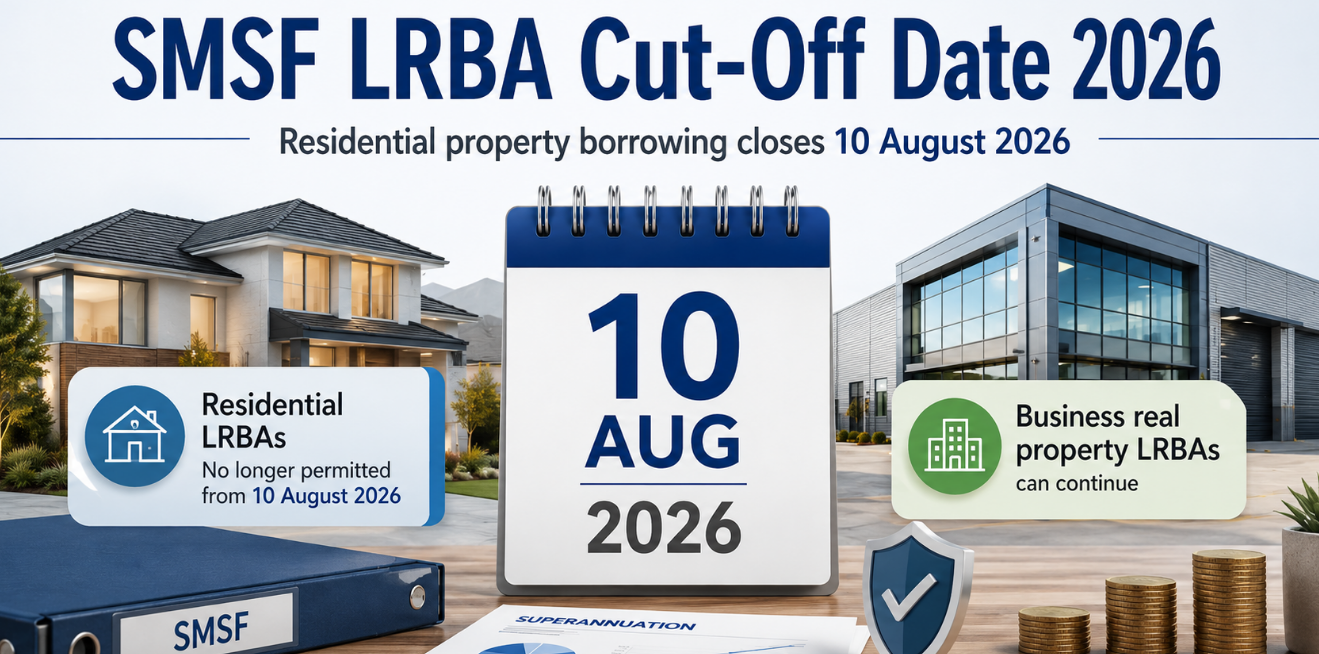
No More Residential LRBAs from 10 August 2026

News | Mehak Gaba | Released: 08/07/2026 | Read: 5 Mins

https://stratus.campaign-image.com.au/images/27408000032672225_zc_v1_1773796813708_screenshot_2026_03_18_064923.png


Borrowing through a Self-Managed Super Fund (SMSF) to acquire property has long been a popular wealth creation strategy, with SMSFs holding an estimated $80.4 billion in limited recourse borrowing arrangements (LRBAs), according to the latest SMSF statistical report.


However, following Royal Assent on 26 June 2026, the Government has confirmed that SMSFs will be banned from using LRBAs to acquire residential property from 10th August 2026. From that date, SMSFs will only be able to use an LRBA to acquire "business real property", rather than residential property. But what about existing residential LRBAs? 


As a general rule, super funds are prohibited from borrowing. LRBAs were introduced in 2007 as a limited exception, allowing SMSFs to borrow in specific circumstances to acquire a "single acquirable asset".


For many trustees, LRBAs have been a legitimate strategy for building wealth within super, particularly given the concessional tax treatment on rental income and capital gains. Rental income is generally taxed at 15% in accumulation phase, while capital gains on assets held for more than 12 months may be taxed at an effective rate of 10%. For members in pension phase, both may effectively reduce to nil.


For trustees considering a property purchase through their SMSF, this is a significant change. Will the fund still be able to borrow to acquire property? Does the ban apply only to residential property, or more broadly to property that is not business real property? What happens if the SMSF was already in the process of entering into an LRBA before the commencement date? And could a mixed-use property fail the business real property test?


These are important questions for SMSF trustees. In this newsletter, we explore each of them and explain the changes as simply and clearly as possible.


What is "Business Real Property"? 


Business real property (BRP) is a defined term under subsection 66(5) of the Superannuation Industry (Supervision) Act 1993 (SIS Act).

  • Broadly, BRP refers to any freehold or leasehold interest in real property that is used wholly and exclusively in one or more businesses, whether or not the business is carried on by the entity that owns the property.
  • In practical terms, the key issue is not simply whether the property is labelled residential or commercial, but how the property is actually used. To qualify as BRP, the property must generally be used wholly and exclusively in a business.
  • The ATO’s interpretation of BRP is set out in SMSFR 2009/1 – Self Managed Superannuation Funds: business real property for the purposes of the Superannuation Industry (Supervision) Act 1993, which provides guidance on how the BRP rules apply in practice.

Case: When Residential property satisfy the definition of "Business Real Property" 

The key test is not simply whether the property is residential or commercial — it is whether the property is wholly and exclusively used in a business? 

  • Some residential properties may still qualify as business real property if they are genuinely used in a business. For example, a residential property that forms part of a property development business, or a sufficiently large rental property business, may satisfy the business real property test.
  • Some commercial properties may fail the test if they are not used wholly and exclusively in a business. A mixed-use property, or a commercial property partly used for non-business purposes, may therefore not qualify as business real property.
Example – residential property that may qualify as BRP:
  • Mr Wood owns 20 residential units that are leased to long-term residents. Mr Wood manages and maintains the flats on a full-time basis living on the income generated from the leases
  • The units are not mortgaged
  • Mr Wood would like his SMSF to acquire some of the units rather than sell the units to a non-related party
  • The scale of the operation, together with the elements of repetition and purpose, indicate Mr Wood is carrying on a property investment business
  • Even though the tenants use the properties for their own private or domestic purposes, this use remains incidental and relevant to Mr Wood's property investment business. Consequently, Mr Wood's interest in the property on which the units are built is business real property. Provided the acquisition takes place at market value, the units may be acquired by the SMSF without contravening the related party asset acquisition rule in section 66.

Why Did the Government Ban It?

  • The first is housing affordability. The argument is that SMSF borrowing to acquire residential property directs retirement savings into the established housing market, placing SMSF investors in competition with owner-occupiers and other buyers.
  • The second is systemic risk. For some time, APRA and the RBA have expressed concerns about leveraged residential property exposure inside self-managed super funds. Under an LRBA, the lender’s recourse is generally limited to the asset acquired with the borrowed funds, rather than the SMSF’s other assets. This means that if the loan defaults and the sale of that property does not fully cover the debt, the lender bears a greater share of the downside risk. Combined with concerns around leverage in residential property, this has been one of the reasons cited for restricting SMSF borrowing in this area.
 

Whether or not one agrees with those policy reasons, the position is now clear: the legislation has passed. The practical question for trustees and advisers is what this means in practice, and what steps should be considered next.


What’s still allowed?


While the headlines have focused on a “ban”, several important aspects remain unchanged.

  • Commercial property that meets the business real property definition
  • Shares or units in managed investments – as long as it treats the whole holding as a single indivisible investment (ie, the SMSF couldn’t sell part of the holding while the LRBA was in place).
  • Residential properties already owned by an SMSF.
  • Residential property purchased without borrowing.
  • Existing residential LRBAs established before 10 August 2026.
   

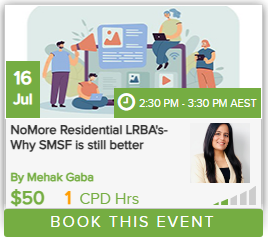
Join My Webinar- 16th July 2026!


What we will discuss in this webinar ?

  • What are LRBAs? When will the LRBA ban start?
  • Why are LRBAs under scrutiny?
  • What is changing ?
  • What happens if LRBAs are banned?
  • What is still allowed ?
  • Why SMSFs are still King ?
  • Alternative Investment Strategies.
  • Who will be affected the most?
  • Practical Considerations for Trustees and Advisers.
   

Only Four Weeks Remain


If you are planning to purchase residential property through your SMSF using borrowings, it is important to start the process as soon as possible. Depending on your circumstances, this may involve:

  • Registering a new SMSF with the ATO (if applicable).
  • Opening the SMSF bank account.
  • Rolling over existing superannuation benefits into the SMSF.
  • Establishing the bare trust.
  • Signing the contract of sale before 10 August 2026.
  • Obtaining formal finance approval.

Every transaction is different, and professional advice is essential to ensure the required steps are completed before the legislation commences.


Final Thoughts


The residential LRBA ban may affect more than just SMSF trustees. It could also impact developers who rely on SMSF buyers for presales in new projects, as well as lenders and brokers with existing SMSF lending pipelines or a significant volume of SMSF borrowing business. The practical impact of the changes will become clearer over time as the market adjusts.

Visit www.trustdeed.com.au for more details or call us on(02) 9684 4199

Follow Us On

 You are receiving this email as you signed up for our newsletters.

 Want to change how you receive these emails?

You can Unsubscribe or Update your preferences


click here to unsubscribe from the mailing list
Share