Share
Biggest SMSF Changes You Can't Ignore in FY2026
 

Biggest SMSF Changes You Can't Ignore in FY2026

News | Mehak Gaba | Released: 30/07/2026 | Read: 5 Mins

Superannuation rules are changing from 1 July 2026, and these changes may impact how Australians contribute to super, plan for retirement, and manage their SMSFs.


Whether you are salary sacrificing, making additional contributions, approaching retirement, or managing an SMSF, the new financial year introduces important changes that require careful planning. Key updates include changes to contribution strategies, the introduction of Division 296 tax for individuals with larger superannuation balances, and changes to SMSF borrowing arrangements, including LRBA rules.


These are important changes to understand as the new financial year begins.


This article explains what is changing, who may be affected, and the key considerations you should review to ensure you are prepared for these new rules.

https://stratus.campaign-image.com.au/images/27408000033969003_zc_v1_1785394581959_screenshot_2026_07_30_122551.png
   

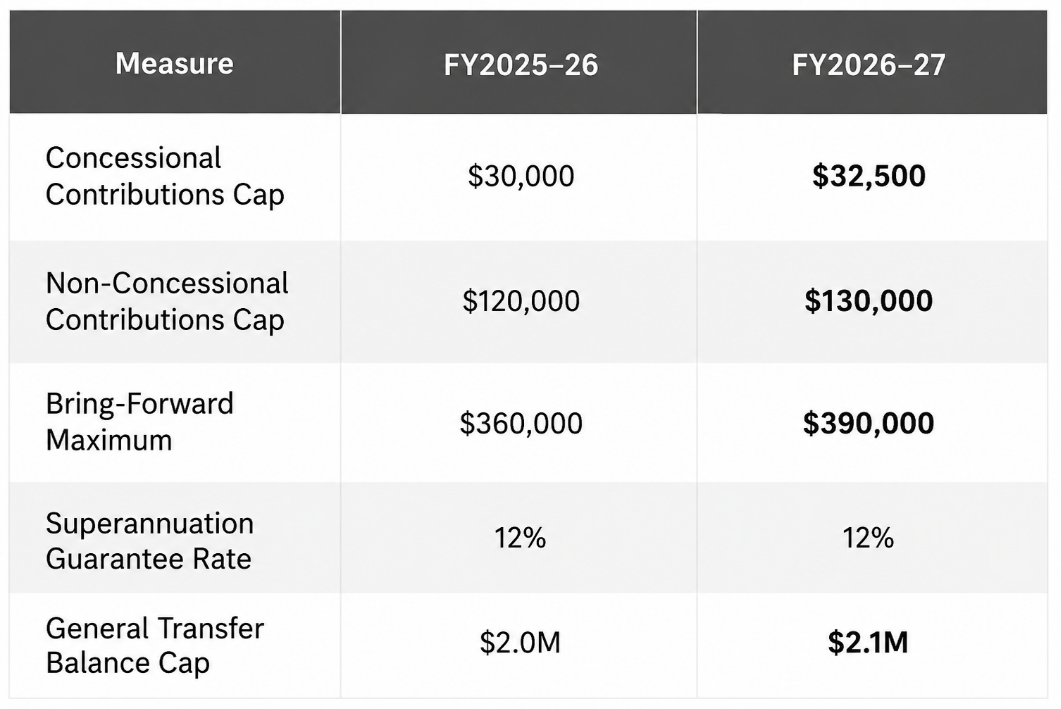
Key Numbers at a Glance: Super Changes 2026-2027

   
https://stratus.campaign-image.com.au/images/27408000033969003_37_1785386162087_zc-noimage.png
   

Budget Changes Make Super Even More Attractive


Recent Government tax changes may affect how Australians invest and manage their tax outside superannuation. If you own property, shares, ETFs or cryptocurrency, or invest through a discretionary trust, these changes could impact your investment strategy and future tax position. For years, Australian investors have relied on three key tax concessions to build wealth:


1. Negative Gearing: From 1 July 2027, individuals purchasing residential investment properties after 7:30 pm on 12 May 2026 will no longer be able to offset rental losses against salary and wage income.

Rental losses can only offset future residential investment income.


Current Negative Gearing Rules through an example


Lina earns $85,000 per year and owns an investment property. The property generates $10,000 in rent but incurs $20,000 in expenses, resulting in a $10,000 loss.Under the current rules, this loss can be offset against her other income, reducing her taxable income to $75,000 and lowering her tax payable. 


2. Discretionary Trust Changes: From 1 July 2028, Discretionary trusts distributing income from diversified share portfolios will generally become subject to a 30% minimum tax on distributions, substantially reducing traditional income-splitting opportunities.

  • A 30% floor — not a cap this means that if a beneficiary’s effective tax rate is above 30 percent, they will still need to pay additional tax, while those taxed below 30 percent will not receive a refund for the difference. 

  • Why it matters? The proposed Budget states that the “growing use of discretionary trusts is increasingly unsustainable” and supports this with the following data:


    • Discretionary trusts have doubled since 2001–02, growing faster than companies (+70%).
    • Australia now has 1M+ trusts; ~80% are discretionary trusts.
    • In 2022–23, they distributed $142.4B income, growing ~7.8% annually since 2011–12.
    • Most trust income goes to the top 10% of earners.
    • ~90% of private trust wealth is held by the wealthiest 10% of households (net worth > ~$2.3M).
Current Rules through an example
A discretionary trust earns $200,000 of income, which is distributed among four beneficiaries: $50,000 to the husband, $50,000 to the wife, and $50,000 to each of their two children. Each beneficiary is taxed separately on their share of the trust income, based on their own marginal tax rate, which may result in a lower overall tax liability.Each beneficiary is taxed separately on their share of the trust income, based on their own marginal tax rate, which may result in a lower overall tax liability.


3. Capital Gains Tax Changes:  The Government will replace the flat 50% CGT discount with inflation-based cost-base indexation and introduce a minimum 30% tax rate on real capital gains with effect from 1st July 2027. 

 
Current Rules through an example 
For an Australian resident individual, if you hold an eligible asset for at least 12 months, the current rules generally allow a 50% CGT discount. For example, if you buy shares for $100,000 and sell them for $200,000, your capital gain is $100,000. After the 50% discount, only $50,000 is included in your taxable income and taxed at your applicable marginal tax rate.
 

Why SMSFs Become Even More Attractive

Compared with these new investment rules, SMSFs continue to enjoy significant tax concessions inside an SMSF:

✅ Investment earnings generally taxed at 15%

✅ Capital gains on assets held longer than 12 months generally taxed at 10%

✅ Pension phase investment earnings and capital gains generally remain tax free, subject to current legislation.


Changes to Limited Recourse Borrowing Arrangements


The ATO has released guidance on changes to the limited recourse borrowing arrangement (LRBA) law, which apply to arrangements entered into on or after 10 August 2026.


Key points:

  • LRBAs are not banned. SMSFs can still borrow under an LRBA, but an LRBA entered into on or after 10 August 2026 to purchase real property can only be used to acquire business real property (BRP). There is no change to how LRBAs operate, or to the other exceptions to the borrowing prohibition.
  • All lenders are covered. The identity of the lender, whether a bank, non-bank lender or related party, does not affect whether the property must be BRP.
  • BRP is required at entry and throughout. The property must be wholly and exclusively used in one or more businesses when the LRBA is entered into, and for the entire life of the LRBA. If it isn't, the SMSF has breached the prohibition on borrowing and compliance action may apply.
  • Existing LRBAs are unaffected. LRBAs entered into before 10 August 2026 are carved out, as is maintaining or refinancing them afterwards. The ATO treats refinancing as a new loan contract for the same asset, with the same or a new lender.
  • Binding contracts before 10 August are also carved out. If the SMSF exchanged a binding contract to acquire the property before 10 August 2026, the changes don't apply even if settlement or the LRBA occurs later. Significant variations to the contract may create a new arrangement.
  • Residential property is not automatically excluded. It can be financed under an LRBA if it meets the BRP test at entry and throughout. An SMSF can still invest in residential property that isn't BRP, but not under an LRBA.

Please note that the current deadline for entering into an LRBA for the acquisition of residential property is 9 August 2026. To avoid missing the deadline, please ensure that all relevant contracts are exchanged and binding on or before 9 August 2026. The ATO confirms that binding contracts entered into before 10 August 2026 can fall within the transitional arrangements.


Division 296-  – Tax on Higher Superannuation Balances


Effective from 1 July 2026, Division 296 introduces an additional tax for individuals with total superannuation balances (TSBs) exceeding $3 million. The measure is now law and is intended to reduce the concessional tax treatment available to individuals with very large superannuation balances.


How Division 296 Tax Applies:


Total Superannuation Balance

Additional Tax Treatment

Up to $3 million

No Division 296 tax applies. Earnings continue to be taxed under the existing superannuation tax rules.

More than $3 million and up to $10 million

An additional 15% tax applies to the proportion of earnings attributable to the balance above $3 million. This can result in an effective tax rate of 30% on that portion, combining the existing 15% tax rate with the additional 15%.

More than $10 million

An additional 10% tax applies to the proportion attributable to the balance above $10 million, on top of the additional 15% applying above $3 million. This can result in an effective tax rate of 40% on the portion above $10 million.


Example: Balance above $10 million

Jonathan has a total super balance of $11.5 million on 30 June 2027.

His fund has reported earnings of $500,000 attributed to him

Step 1: Proportion of TSB 1:

= ($11.5 million – $3 million) / $11.5 million

= $8.5 million / $11.5 million

= 0.7391 or 73.91%

Step 2: Proportion of TSB 2:

($11.5 million – $10 million) / $11.5 million

= $1.5 million / $11.5 million

= 0.1304 or 13.04%

Step 3: Apply Division 296 tax

= 15% x 73.91% (proportion of TSB 1) x $500,000 (earnings) + 10% x 13.04% (proportion of TSB 2) x $500,000 (earnings)

= $61,952.50


Changes in Payday Super


Payday Super is a major Australian superannuation reform requiring employers to pay their employees' superannuation guarantee (SG) contributions at the same time they pay their salary and wages, officially commencing on 1 July 2026. This shifts the mandatory payment frequency from a quarterly cycle to a real-time system aligned with weekly, fortnightly, or monthly pay runs.

📋 Key Rules and Changes

The new legislative framework introduces several critical operational updates: 

  • 7-Day Deadline: Contributions must reach the employee's super fund within 7 business days of payday to be compliant. 
  • Qualifying Earnings (QE): The old base of Ordinary Time Earnings (OTE) is replaced by Qualifying Earnings. This broadens the scope to automatically include commissions earned outside ordinary hours, salary sacrifice amounts, and bonuses. 
  • STP Reporting: Employers must report both the year-to-date QE and super liability via Single Touch Payroll (STP) on every payday. 
  • Closure: The ATO Small Business Superannuation Clearing House permanently closes on 30 June 2026. Businesses using it must migrate to a commercial alternative. 
  • Tightened Penalties: Late or missed payments trigger a redesigned Superannuation Guarantee Charge (SGC) assessed directly by the ATO, featuring daily compounding interest and an administrative uplift fee. 
   

Final Thoughts


Superannuation is a long-term game, and even small rule changes can have a big impact over time.


Take the time to review your super, stay informed about potential changes, and consider speaking to a financial adviser if needed. With the right knowledge and strategy, you can make sure your super keeps working hard for your retirement.


Visit www.trustdeed.com.au for more details or call us on(02) 9684 4199


Follow Us On

 You are receiving this email as you signed up for our newsletters.

 Want to change how you receive these emails?

You can Unsubscribe or Update your preferences

 
click here to unsubscribe from the mailing list
Share