Share
SMSF Trustee Obligations: Are You Meeting Your Legal Duties?
 

SMSF Trustee Obligations: Are You Meeting Your Legal Duties?

News | Mansi Sharma | Released: 05/08/2026 | Read: 5 Mins

One of the key benefits of an SMSF is its concessional tax treatment, with complying funds generally taxed at 15%. However, these tax concessions are only available where trustees meet their ongoing obligations under Australia's superannuation laws. Serious compliance breaches, including non-arm's length income (NALI) or a fund becoming non-complying, may result in income being taxed at the highest marginal tax rate of 45%.


As the regulator of SMSFs, the Australian Taxation Office (ATO) expects trustees to understand and comply with their legal duties under the Superannuation Industry (Supervision) Act 1993 (SIS Act). Failure to comply may result in administrative penalties, rectification directions, trustee disqualification, or, in serious cases, the fund being made non-complying.


In this newsletter, we explore the key trustee obligations under the SIS Act, the ATO's current compliance focus, and practical steps trustees and advisers can take to maintain compliance and protect their fund's tax concessions.


Your Obligations as an SMSF Trustee

   
https://stratus.campaign-image.com.au/images/27408000034260194_zc_v1_1773796813708_screenshot_2026_03_18_064923.png
   

Every SMSF trustee has a legal obligation to manage the fund in accordance with the Superannuation Industry (Supervision) Act 1993 (SIS Act). Failure to meet these obligations can expose both the fund and its trustees to significant tax consequences, administrative penalties and trustee disqualification.


Exercise Honesty, Care, Skill and Diligence


As a trustee, you must ensure your SMSF complies with:

  • Your Trust Deed
  • The rules of the Superannuation Industry (Supervision) Act 1993 (SIS Act).

For Example- it is illegal for an SMSF to purchase an asset from a member or lend money to a member (except under strict, limited recourse borrowing rules). Trustees must also ensure transactions with relatives or related parties comply with SIS Act rules – if a deal is not truly arm’s length and it benefits a related party more than if done at market terms, the income can be taxed at 45% as “non-arm’s-length income (NALI)”.


Remember: Every trustee signs the ATO Trustee Declaration acknowledging they understand these responsibilities. (NAT 71089).


Comply with the Sole Purpose Test


Under Section 62 of the SIS Act, every SMSF must be maintained solely to provide retirement or death benefits to its members. Meeting the sole purpose test is essential to retain the fund's complying status and access concessional tax treatment.


Trustees must ensure that fund assets and investments are used exclusively for retirement purposes and do not provide a present-day benefit to members or their related parties.


For example, purchasing a residential property through an SMSF and allowing a member or relative to live in it would breach the sole purpose test. Such contraventions can result in significant penalties, loss of tax concessions and regulatory action by the ATO.


Accept Contributions and Rollovers in Accordance with the Law


Trustees must ensure that all contributions and rollovers are accepted in accordance with the trust deed and the requirements of the Superannuation Industry (Supervision) Act 1993 (SIS Act). Every transaction must comply with the applicable eligibility and acceptance rules.


In addition, trustees are responsible for ensuring that all contributions and rollovers are properly documented, accurately recorded, and allocated to the correct member's account, maintaining the integrity of the fund's records and ensuring ongoing compliance.

https://stratus.campaign-image.com.au/images/27408000034260194_zc_v1_1773796813708_screenshot_2026_03_18_064923.png
   

Develop and Regularly Review Your SMSF Investment Strategy 


Your SMSF must maintain a written investment strategy that complies with the SIS Act. The strategy should:

  • Consider the personal circumstances and retirement objectives of all members.
  • Outline the fund's investment objectives and the types of investments permitted.
  • Address key factors such as risk, diversification, liquidity, cash flow requirements, and whether insurance should be held for members.
  • Be reviewed regularly and updated whenever the fund's circumstances or members' needs change.


When making investment decisions, trustees should maintain appropriate records demonstrating that each investment is consistent with the fund's documented investment strategy.


Pay Benefits in Accordance with Superannuation Law


Trustees are responsible for ensuring that superannuation benefits are only paid when a member has satisfied a valid condition of release under the SIS Act and associated superannuation laws. Benefits must not be accessed or released prematurely. When paying benefits, trustees must ensure they:

  • Confirm the member has met a legal condition of release before any payment is made.
  • Pay benefits strictly in accordance with the trust deed and superannuation legislation.
  • Maintain appropriate documentation to support all benefit payments and demonstrate compliance with regulatory requirements.
   

Value SMSF Assets at Market Value


Trustees are responsible for ensuring that superannuation benefits are only paid when a member has satisfied a valid condition of release under the SIS Act and associated superannuation laws. Benefits must not be accessed or released prematurely.

https://stratus.campaign-image.com.au/images/27408000034260194_zc_v1_1773796813708_screenshot_2026_03_18_064923.png
   

Other Trustee Responsibilities


In addition to above legal duties, SMSF trustees must also:

  • Prepare annual financial statements – Prepare the fund's Statement of Financial Position and Operating Statement each financial year.
  • Lodge the SMSF Annual Return (SAR) – Lodge the SAR on time, pay any tax liabilities, and submit TBARs or Activity Statements where required.
  • Pay annual regulatory fees – Pay ATO supervisory levy and, where applicable, ASIC annual review fees.
  • Notify the ATO of changes – Report changes to the SMSF (ASIC for corporate trustees) within 28 days.
  • Maintain accurate records – Keep records of the fund's decisions, transactions and compliance activities.
  • Meet the residency requirements – Ensure the SMSF remains an Australian super fund to retain its complying status and concessional tax treatment.
  • Appointing a registered auditor- at least 45 days before their fund’s annual return to the ATO is due. This auditor must be independent (that is, have no financial interest in the SMSF, or any personal or business relationships with fund members or trustees).
   

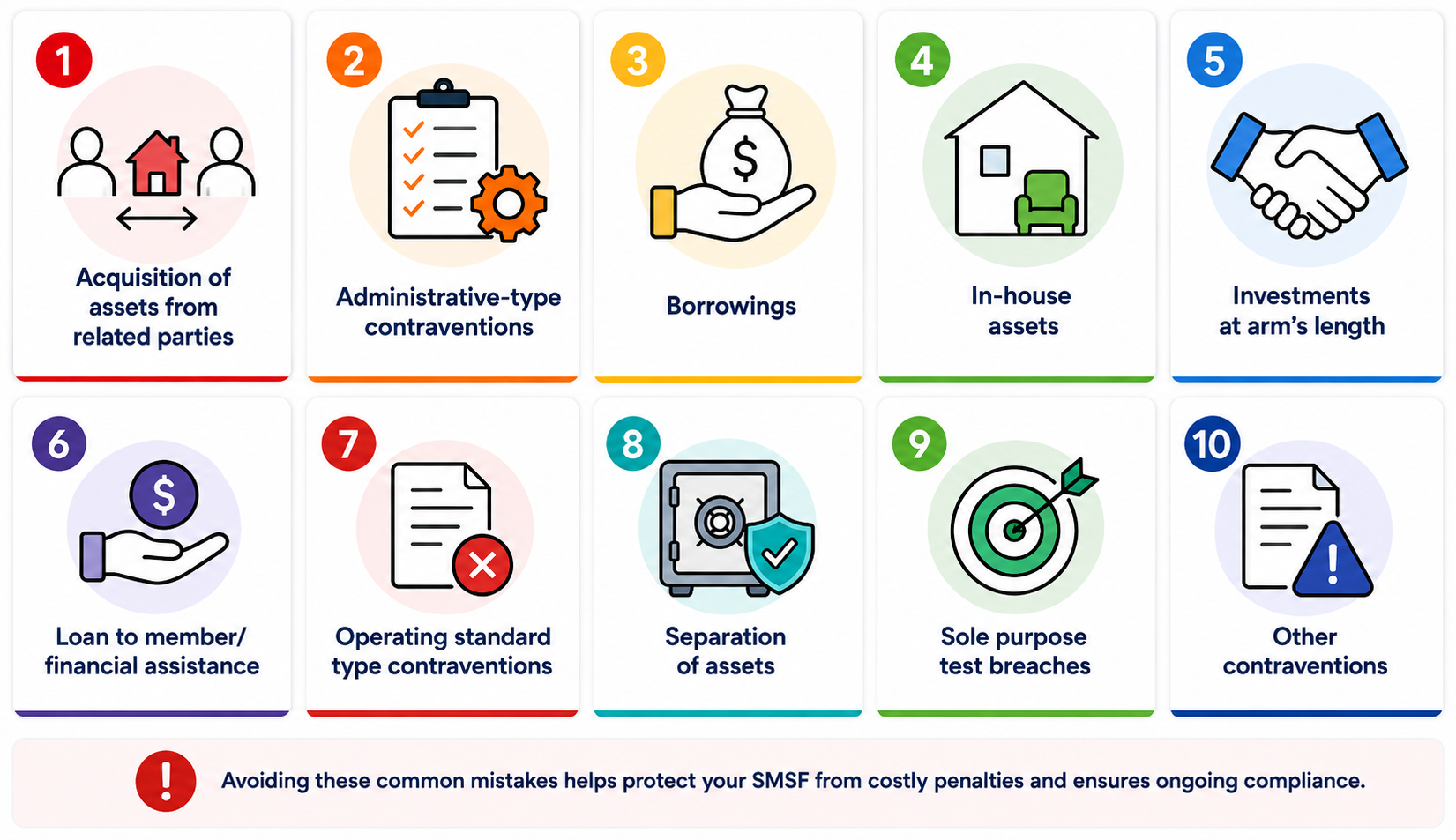
Common Mistakes Made by SMSF Trustees

   
https://stratus.campaign-image.com.au/images/27408000034260194_zc_v1_1773796813708_screenshot_2026_03_18_064923.png
   

Consequences of Non-Compliance


The ATO is the primary regulator of SMSFs and is responsible for Administering Australia's superannuation and taxation laws along with monitoring trustee compliance with SMSF obligations.


Where a trustee fails to meet their obligations, the ATO may take compliance action based on:

  • The nature and seriousness of the contravention.
  • The trustee's compliance history and attitude towards their obligations.
  • The steps taken to rectify the breach.
  • Was it an intentional contravention?
  • When did you inform ATO?
  • Whether the contravention can be rectified, and when and how this will be done
  • Whether the contravention had criminal consequences.
   

Enforceable Undertaking


A trustee may submit a written undertaking to rectify a contravention. If accepted by the ATO, the trustee must comply with the agreed actions.

The undertaking should outline:

  • The steps taken to stop and rectify the contravention.
  • The timeframe for completion.
  • How the trustee will report the rectification.
  • Measures to prevent future breaches.

Failure to comply with an accepted undertaking may result in further ATO compliance action.


What To Do If You Have Breached the Law?


SMSF auditors are required to report certain breaches of superannuation law to the ATO and the trustee. These breaches, known as contraventions, should be addressed and rectified promptly.


Trustees may voluntarily disclose unrectified contraventions through the ATO’s SMSF Early Engagement and Voluntary Disclosure Service, with the trustee’s actions taken into account when determining any penalties.


Depending on the circumstances, the ATO may impose:

  • Administrative penalties.
  • Income tax assessments.
  • Trustee disqualification.
  • Freezing of SMSF assets.
  • Civil or criminal penalties.
  • Change of the fund’s status to non-complying.
  • Rectification or education directions.
   

Final Thoughts


Being an SMSF trustee offers significant control and valuable tax concessions, but it also comes with substantial legal responsibilities. Ongoing compliance is essential, not only to protect the fund's complying status but also to safeguard members' retirement savings. By understanding your obligations and addressing issues proactively, trustees can minimise compliance risks and ensure the long-term success of their SMSF.


Visit www.trustdeed.com.au for more details or call us on(02) 9684 4199


Follow Us On

 You are receiving this email as you signed up for our newsletters.

 Want to change how you receive these emails?

You can Unsubscribe or Update your preferences

 
click here to unsubscribe from the mailing list
Share